
Book Review: PROJECT HAIL MARY Is a Home Run

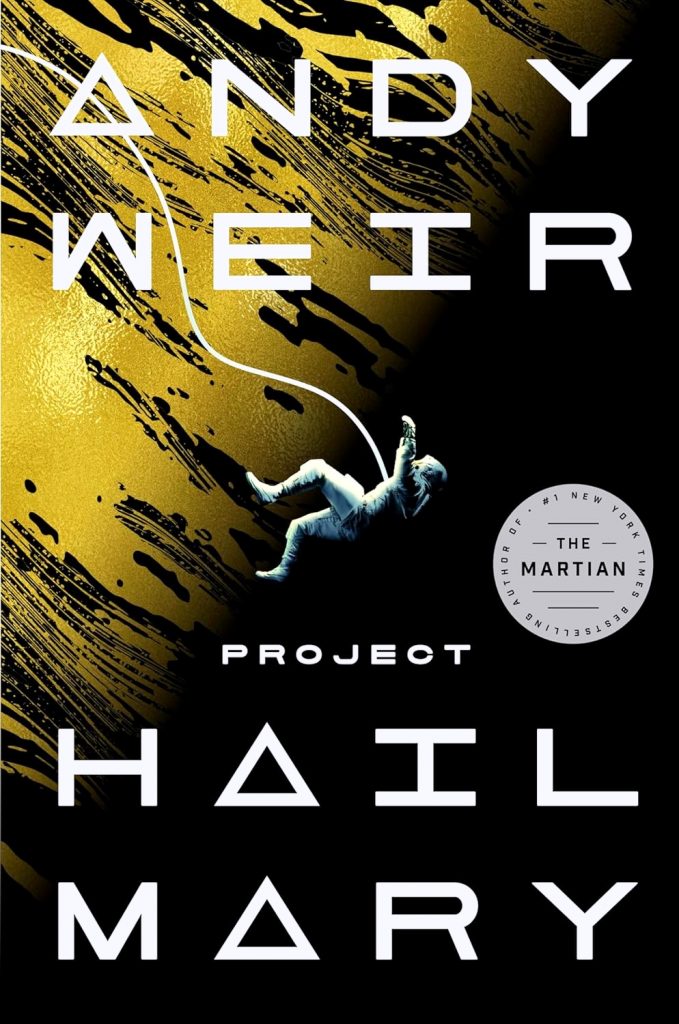
Project Hail Mary
Written by Andy Weir
Published by Minotaur Books
April 21, 2026
Hardcover, 288 pgs.
Earlier this year, I reviewed the movie adaptation of Project Hail Mary, noting that I hadn’t yet read the book. Well, now I have, and I get to let you know what I thought about the source material. And probably to no one’s surprise, I enjoyed the book as much as I enjoyed the movie.
In fact, there’s a small chance I might have enjoyed the book a little better, because there’s more detail in how Ryland Grace gets from point A to point B, and the flashbacks deliver more information on how the crisis evolved and how Eva Stratt moved Heaven and Earth to save humanity.
The story in the book is the same as in the movie, of course, with a few slightly different details. For one, there is no character named Carl in the book. He appears to have been constructed for the film in order to facilitate exposition as Ryland figured things out on how the astrophage worked. Talking with Carl in the movie replaces the on-going internal monologue in the book, wherein Grace goes through step-by-step in his research, noting the various scientific aspects of the work along the way. And those scientific details are important in that they pave the way for us to understand how Grace can use the knowledge he has to work with Rocky and develop a solution to save both planets.
Recruited from his classroom by Stratt, Grace is one of many scientists trying to find a solution to the Petrova Line, a sequence of particles moving between Venus and the Sun while draining the Sun of its energy. After a certain number of years, it’s determined, Earth will cool to the point where humanity will likely die off due to the loss of solar energy and the impact that will have on the planet’s ecosystem. After scanning nearby stars, they discover that while Tau Ceti has its own Petrova Line, it does not appear to be affecting the star. So a team of astronauts will be tasked with travelling the distance on a one-way trip to discover just what makes Tau Ceti immune in the hopes of getting that information back to Earth in time to make a difference.
One thing I don’t remember being in the movie, but it could be just because it’s been a while since I watched it: the genetic marker that allows some people to tolerate long-term induced coma. Grace has it, which is why he becomes the replacement science specialist on the mission after the accident that kills both the primary and the backup specialists just weeks before the launch. Another difference: there is no comedic-ish running from the needle in the book. It plays out much more as a straightforward betrayal by Stratt, regrets notwithstanding.
And after reading the book, I have to agree with screenwriter Drew Goddard and would have liked to see the nuclear bombardment of Antarctica.
Also of note: I thoroughly enjoyed the fact that Andy Weir is not one of those “trying to be Joss Whedon” writers. Yes, his story has humor, but it’s not snarky over-the-top twentysomething slang that no one should be using ever, and the humor comes in the midst of circumstances that need humor to let everyone breathe.
Rocky is pretty much in the book the same as he is in the film, only with more elaborate explanations as to how Grace puts together his translation program on the laptop. It’s not glossed over in the film so much, but the book has more detail as to how Grace figures out Rocky’s method of communication uses musical frequencies in layers to convey concepts and ideas. It’s an intriguing notion, and I’m glad the book explores this a bit more. Would have taken up too much time in the film, of course, but then everything does when you’re adapting book to movie.
This is also one of those rare exceptions to my “present tense bad” rule. It’s not something that an author can get right very often (looking at you, Wendig…), but in this case it absolutely works because Weir uses it to separate what Grace experiences on the ship with his memories of how he got there. Not only does it serve up some narrative separation between events, but it also acts as a visual cue to the reader as to where we are in the story. Grace’s memories bubble up to the surface as he encounters different aspects of the ship, the mission, the fact that he’s on a one-way mission to Tau Ceti, with two corpses aboard… Weir weaves the flashbacks into the narrative in a natural organic way that doesn’t jar the reader with the jump from past to present, and the shift from past tense to present tense aids in that transition to make it smoother. I almost didn’t notice it until I did.
Honestly, as much as I enjoyed the movie, I think I like the book just a tad bit more for its additional detail and scientific elements. I have no doubt this one will be on my “read again” pile, and I’m now primed to read The Martian and Artemis.



i finally saw Project Hail Mary. Good film. i didnt like Dr. Grace being a super over the top coward when he first wakes on he Hail Mary, but i thats a creative choice between director and actor i guess. That early aspect rubbed me entirely the wrong way.
That aside, i think there’s a lot of book material that was stuffed in for time constraints, as opposed to the typical being left out for time constraints. The scientific discovery on Earth felt rushed for time, and the sequences on the Hail Mary overall felt rushed.
Good film, just feels a bit backwards. Scenes that were rushed should have been longer, and the longer scenes could have been cut down or edited out.
I think the space scenes on both ships should have been the bulk, and the flashbacks much shorter. Serving as exposition dumps. That gives it a feel of being just slightly off overall. The structure of the film is what i’m referring to. Every adaptation leaves or adds or changes. I Think the film would have been better served by half of the film being Grace and Rocky trying to figure out a way to save Rocky’s ship and devising a different containment solution, after discovery of the Predator lifeform that eats Astrophage.
Overall a good film. i understand the “light comedy” usage. I dont recall a sci-fi film this good since Arrival back in 2016. This film for me isnt on that level, but its the best offering we’ve gotten from Hollyweird since, and that alone says something.