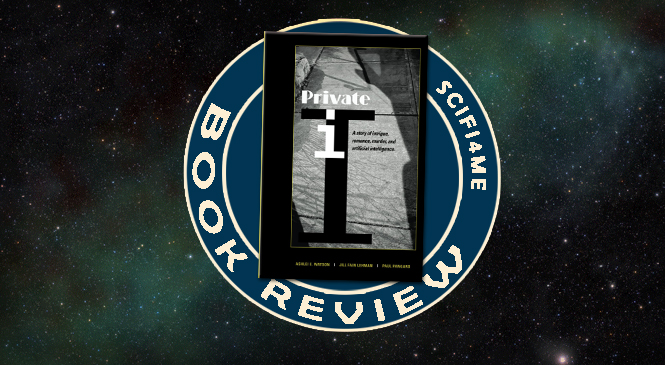
Book Review: PRIVATE I Mixes Lite Noir and Spy Tech

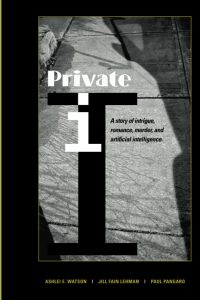
Private I
Written by Ashlei E. Watson, Jill Fain Lehman, Paul Pangaro
Independently Published
February 15, 2023
Softcover, 237 pgs.
Imagine a world where the COVID lockdowns had continued, with all of the masking and vaccination policies in place, only to collide and combine with the current year artificial intelligence hypegasm.
Now throw in a murder and a cyborg-ish fugitive, and you have the beginnings of Private I.
In a world where everyone is walking around attached to a personal digital device, young Paloma Simonetta finds herself the target of a number of groups who would like to get their hands on Marlowe, her personal digital device that’s more than what anyone understands. The product of her grandfather’s research, Marlowe is more than just the latest version of an iPad. It’s got a personality, initiative, and it has access to all sorts of spots all over the web.
When Paloma’s grandfather turns up dead and the farm ablaze, Paloma and Marlowe find themselves on the run with no clue who’s responsible. Nor do they know who’s trustworthy, so when Paloma dives under a false identity, Mira, she’s very cautious about who knows anything about her past.
As Paloma searches for clues about who could have killed her grandfather, she encounters law enforcement, neo-Luddite activists, and other scientists, all of who want to know just what Marlowe’s capabilities are. Do they want to convert the code for their own nefarious plans? Do they want to destroy the program? Can Marlowe help Paloma suss out the dastardly fiend who did the dirty deed before she’s falls victim? And what consequences will there be because Paloma didn’t follow her grandfather’s instructions to destroy Marlowe?
Written in 2023, there’s a clear pandemic-era impact in the story, with everyone wearing masks and the latest variant requiring the latest vaccines and such. Fortunately, it’s only a very minor element, and it actually gives Paloma a way of talking to Marlowe in secret, having a haptic sensor set in the mask to read her lips while Marlowe talks to her through her ear cuffs.
There’s also a minor supporting character using they/them pronouns, which is annoying, but the character doesn’t have enough page time for it to really be a reason to put the book down. It’s an artifact of a particular mind-bent era in our history, and there will be research papers written about it in the future, I’m sure.
Those elements aside, Private I is an easy read, with a clear story that takes you through the search for a killer while at the same time tracking Paloma/Mira as she builds a new life for herself, finding new friends and hobbies while keeping Marlowe a closely guarded secret. Her investigation — couched as a research paper on the possibility that A.I. could one day be sapient — puts her in contact with various people she considers suspects in the murder.
The sapience versus sentience through line adds an interesting layer, as various characters discuss whether or not digital devices — artificial intelligence on steroids — could one day gain sentience, or even grow mature enough to develop sapience, the wisdom that comes from experience and not just the collection of data. Marlowe certainly seems to demonstrate a bit of that, having the ability to advise Paloma in her search for her grandfather’s killer.
This is also not the first story I’ve encountered where there’s a visible anti-AI contingent. Serena Straus’ ReInception series also has that element, and I expect to see more of it as we plunge head first into the assault on our critical thinking skills that is the modern internet augmented by machine learning models and slop code that lets you liberate your prurient inner 14-year-old boy again.
While the story isn’t rushed, the ending does feel a bit abrupt and sudden; it’s a payoff that isn’t quite set up fully at the beginning, but later on as she’s conducting her “research” for the paper she’s supposedly writing. In fact, the opening scene in the book — the funeral of her grandfather’s colleague — introduces us to a number of characters who might be interesting, but they never show up again. Dr. Pavel Zhijecki, for instance, could have figured into the neo-Luddite story with ease.
I did like the fact that Marlowe is more like Alfred Pennyworth than HAL9000. But I would be hard pressed to accept the notion that we all would submit to wearing such devices as part of our everyday lives, even to the point of having such things as implants. Despite what Elon Musk would have you think about Neuralink, it’s not something I want any part of, and I don’t think I’m in the minority on that. Nor do I think wearable devices are going to have that much appeal in the long run. I rather think that the opposite will prove to be the case, as the younger generations are gravitating toward the lo-fi tech of VHS and vinyl more frequently.
The age of surveillance tech is here, but I suspect more people are going to reject it as time marches on.
Maybe that’s the next digital revolution: a total rejection of digital in favor of analog. Maybe the Neo-Luddites are onto something…
Private I is worth the time to read, if only to see what kind of dystopian future we dodged.