
Book Review: JOURNEY TO 2125 Wanders but May Have a Subtle Point

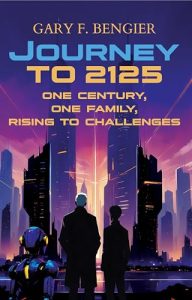
Journey to 2125: One Century, One Family, Rising to Challenges
Written by Gary F. Bengier
Published by Chiliagon Press
September 30, 2024
Paperback, 394 pgs.
I’m still trying to figure this one out.
On the one hand, Journey to 2125 is a fairly straight-forward story: Grandpa Max is telling the Grandson about the family history, with the narrative bouncing back and forth between the “now” of 2125 and the “then” of various years as Max grew up as an adopted member of the MacGyver family. Truth to tell, there’s not much to this story; it’s a little boring on the surface. I found myself wondering if I was going to finish it, especially after I lost count of how many times Bengier brought up climate change.
But then it hit me: what if there’s something more here? I started looking at the way in which climate change was woven into the narrative, along with the fact that Max grew up to be an engineer building nuclear reactors. And I began to wonder: what if the family history layer is just a delivery system for a deeper meaning? What if Bengier is taking the language of the environmentalists — language that’s usually used to hamper viable solutions — and taking using it to build a case for fission?
The reason I started thinking that is that the dialogue, in places, feels like it’s all been lifted from some environmentalist policy brochure. Stilted. Characters are saying the words in the book, but the words feel like they were written by a public relations team for some lobby group trying to get some Green New Deal in front of every elected official in Washington. But that same dialogue actually ends up working in support of nuclear power. The end goal is the end — or at least a reduction — of the world’s dependence on fossil fuels (which actually aren’t, but that’s a different discussion….). As Max grows into adulthood and starts work as a nuclear engineer, bringing power plants online all over the world, he makes the case for it being a steady and clean source of energy. It’s almost as if the author is turning the radical environmentalist thinkspeak against their own cause.
And this is my dilemma, because in and of itself, there’s really not much of a story here. Just Grandpa Max telling family anecdotes to the grandson. Each nugget of family history plays out with various layers of drama — in some cases, not that much — and the whole thing builds to a reveal about Grand’s parents that feel like a natural organic outcome from pieces of the story. But overall, there’s not much there there. About a third of the way through, I was left wondering if there was any point to this narrative, and I seriously considered putting it down and counting it among the random misfires I’d come across over the course of my reading excursions. But I kept going, allowing for the chance that Bengier was up to something. I’m glad I stuck with it, because not too long after that is when the “aha” moment hit and I saw the brochure text for what it was.
Or rather, what I saw. It’s entirely possible that Gary Bengier wrote this book without any kind of plan to subvert the radical environmentalist cadre and make a solid case for nuclear power, but given the times we’re in, and given just how much the environmental movement still clings to the desperate misguided hope that solar, wind, and water power will somehow overtake fossil fuels, you never know… Add to that a thread that delivers a not-so-subtle warning against “artificial intelligence” and autonomous robots, and I’m fairly certain I’m seeing what I think I see. I will allow for the possibility that my own biases are making me see something that isn’t actually there, and I’m sure that the question will arise next time I get a chance to have a conversation with him.
From a craft angle, the narrative is well-written. The scenes flow from one to the next with reasonable fluidity, and the narrative builds in an organic way that adds layer upon layer to the family history. What may seem innocuous in one chapter becomes the foundation for something completely different in a later chapter, and something small in a later chapter may pay off a Chekhov’s Gun moment from previous chapters. Grandpa Max is the thread that weaves it together, and I find it interesting that we get two first-person narratives in the midst of the “flashback” tone of the main part of the story. I can see having Max’s point-of-view, and I suppose it makes a certain amount of sense to get the kid’s reaction to it as the story builds.
I may have to read it again, and I will go ahead and recommend it for you to pick up as well. Tell me if you see what I see. Let’s compare notes, maybe sometime around 2125….